

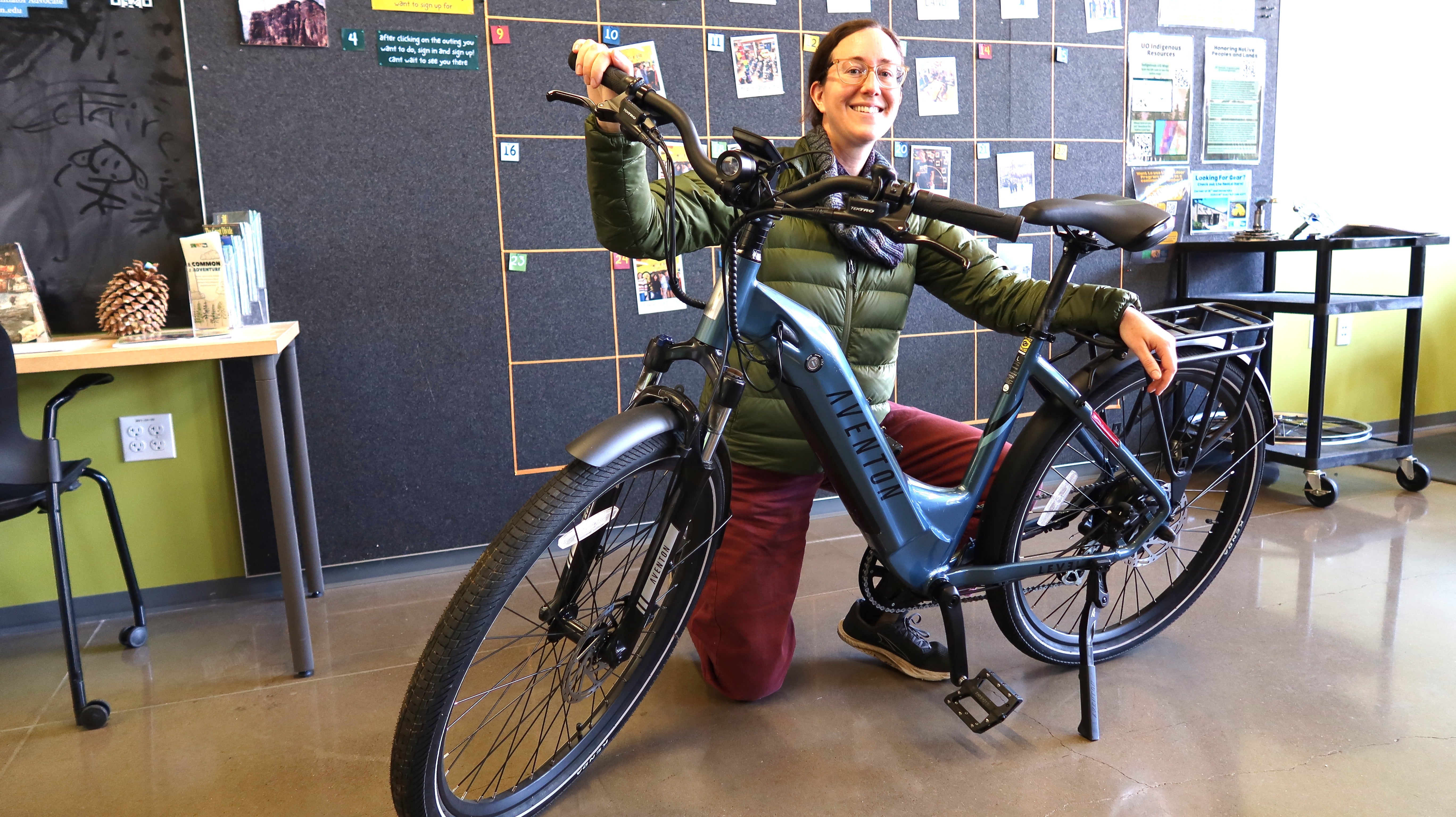
There are lots of options for electric bikes out there: Do you want a throttle? How much range do you need? What style is right for you? How much do they weigh, let alone cost?
If you’re curious about e-bikes, start answering your questions at the UO E-Bike Lending Library, where staff, faculty and students can try an e-bike free for up to two weeks.
The 3-year-old lending library is proving popular, with about 200 loans recorded and a wait list that has stretched up to three months. E-bike loans are currently available in a month or less; reservations can be made through Transportation Services, which partners with the UO Outdoor Program’s bike program on the lending library.
“The goal is to get people to try an e-bike out,” said Rachel Glaeser, active transportation coordinator with Transportation Services. “You wouldn’t just go out and buy yourself one, given the learning curve.”
E-bikes are equipped with a battery and a small electric motor to help you pedal faster and farther. They can cost $1,000 or substantially more, although EWEB customers can get a $300 rebate on a qualifying purchase.
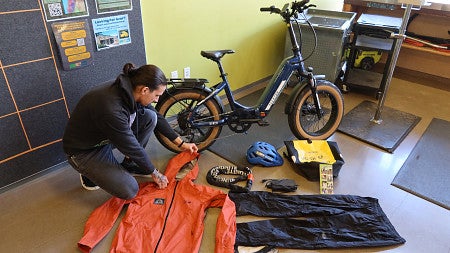
There are numerous e-bike retailers in Eugene-Springfield, but their trial periods are typically much shorter than the two weeks offered through the university.
That made the difference for Nancy Novitski, a strategic communications specialist with Information Services, who borrowed an e-bike through the lending library before buying one last year.
Novitski wanted to test e-bikes on the steepest hill she rides heading home from work to south Eugene. She calculated the grade at 10 percent; for perspective, the grade of the 18th Avenue hill eastbound from Hilyard Street is about 4 percent.
Novitski tried e-bikes from several local shops, but many didn’t allow test rides across town. Through the UO program, she repeatedly tested an e-bike on her hill. The lending program also helped her answer other questions before buying, including which kind of e-bike would be best for her and how and where she would store it at home and at work.
“E-bikes are an investment, and choosing one can be complicated,” Novitski said. “The fact that you can check out a bike for two entire weeks is pretty amazing. You can actually go through your normal daily routine and see how the bike functions. The lending library helped me understand what I was looking for — and once I found something that did seem right, it helped me feel more confident that it would be the right choice for me.”
Novitski’s experience is typical for UO people who try an e-bike through the lending library.
Anne Brown, an associate professor in the School of Planning, Public Policy and Management who specializes in travel behavior, surveyed UO e-bikers who used the lending library and found:
- 90 percent tried biking to the Eugene campus, but some also used an e-bike for recreational trips and errands.
- 58 percent biked at least four days per week during the loan period.
- 80 percent were considering purchase of an e-bike, and 15 percent did so within six months of the loan.
- Participants said e-bikes helped them overcome barriers to traditional bikes including hills, long distances and arriving sweaty to a destination.
The lending library has 12 e-bikes and models with different ranges, options for a throttle, turn signals and even some that are foldable or can carry nearly 300 pounds in cargo.
Riders are given a one-hour orientation that includes a test ride, review of the mechanical system, safety tips and other biking information. For more information, visit the E-Bike Lending Library.
—Story and photos by Matt Cooper, University Communications