

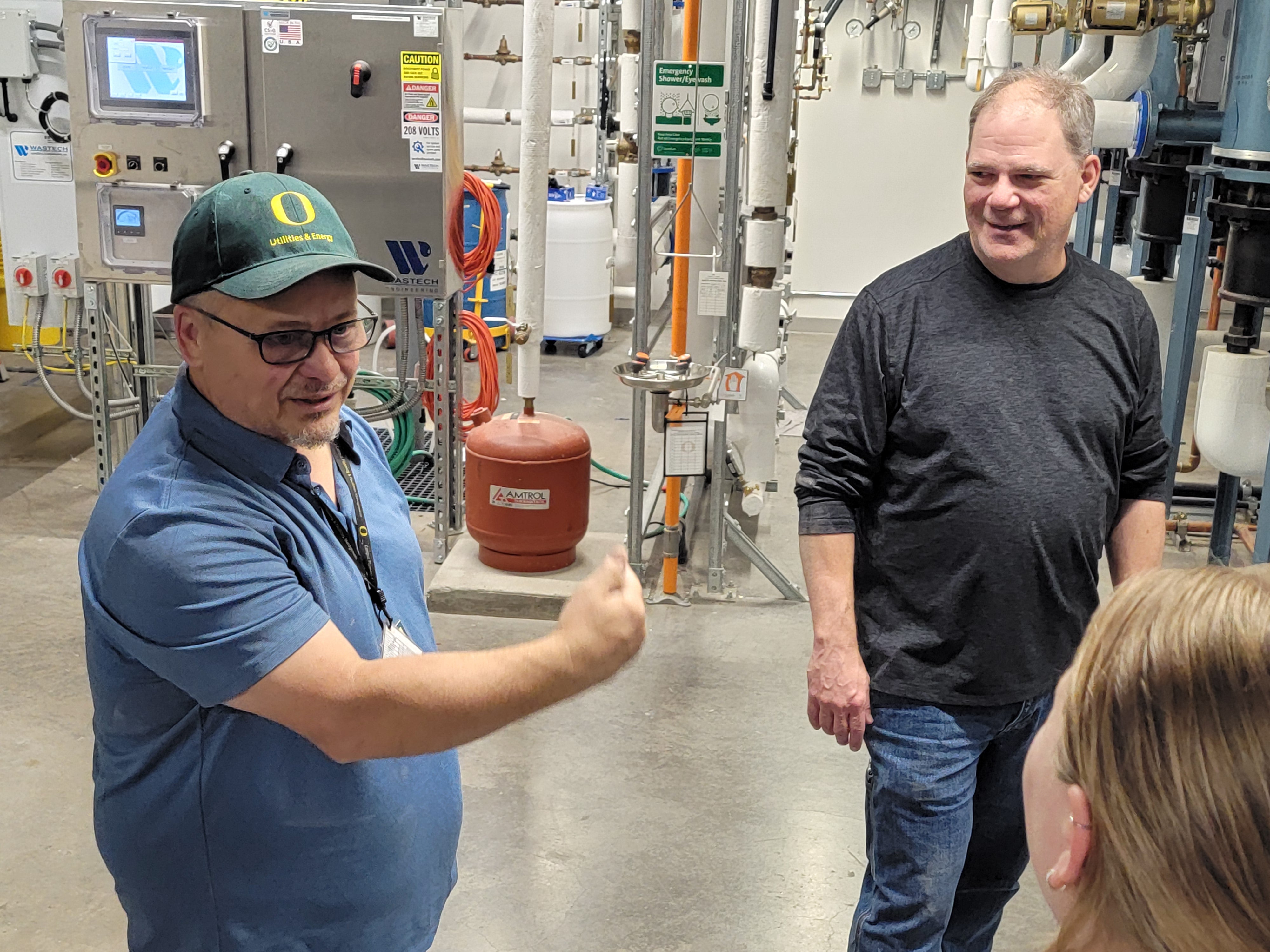
Rick Tabor has been at the University of Oregon for 18 years. He’s an associate director with Utilities and Energy and given his vast experience, few people in the unit would be comfortable needling him.
Except maybe his counterpart, Paul Langley, also an associate director with the unit — but with 23 years at the UO.
Tabor was pondering a name for his electrical crew recently when Langley offered some tongue-in-cheek suggestions: “Team Butterfly? Team Buttercup?” Then he winked at a writer: “We sometimes have a little fun.”
Tabor just rolled his eyes. “You’re gonna get payback,” he said, grinning.
It’s possible the ribbing owes in part to the fact that Tabor is an old Army man and Langley served in the Navy. But camaraderie is also a hallmark of Utilities and Energy, which shoulders the responsibility of keeping the lights on at the UO 365 days a year.
This responsibility is never greater than during an extremely stressful day of testing each summer. That’s when Tabor, Langley and more than 20 people inside and outside the unit sync up like a symphony, ensuring UO resilience in an emergency and epitomizing the university’s spirit of teamwork.
Each summer, Tabor, Langley and Steve Mital, utilities director, run a day of electrical testing during which the unit repeatedly switches the Eugene campus off EWEB power and onto the UO’s own power-generating systems. This eight-hour test, called “island mode,” is critical for world-class research facilities that must ensure power to sensitive science equipment despite disruptions from storms or a catastrophic event.
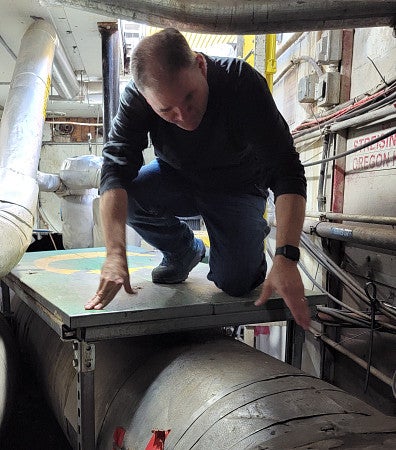
The UO generates power through the Central Power Station, a plant off Franklin Boulevard that includes a gas-fired turbine and diesel generators. Together, the machines can generate more than 14 megawatts of electricity — enough to power more than 10,000 homes. The facility is a backup for EWEB power and the annual training of staff and testing of equipment help ensure readiness in a crisis, Mital said.
The stakes are high during the electrical test, given the untold value of UO assets vulnerable to power disruptions and the unpredictability of impacts when an enterprise of the university’s size switches power sources.
But over the years, Tabor has grown increasingly comfortable the test can be done without big disruptions to campus. That’s due to his confidence in the 20-plus people involved — electricians, operations crews, communicators — and what they bring in experience, expertise and teamwork.
“We’ve built this cohesive team — the right hand always knows what the left hand is doing and everyone is very, very, very proud to be here,” Tabor said. “This is our Game Day.”
The testing day requires minute-by-minute coordination between Tabor’s electricians, Langley’s operations crew and Mital’s communications team. One way to think about it: electricians perform the tests and troubleshoot problems at the same time that operations crews are delivering power to campus through the power station. Communicators, meanwhile, monitor everything, sending out continuous test updates to key stakeholders and responding quickly to concerns.
“This whole process has developed into a pretty smooth operation,” said Dave Harris, lead electrician.
“We’re like a sewing machine,” added Kiles White, lead co-generation engineer.
Harris and White aren’t just colleagues, but friends. That’s a good thing, because the electrical tests that Harris runs can disturb the building-sized industrial equipment that White helps operate at the power station — diesel generators, chillers and boilers that serve campus.
“We’re a family over here,” Harris said. “We can be straightforward with each other, none of this dancing around an issue — we can’t afford to be misinterpreted. We’re all looking out for each other and making sure we don’t put any of us into danger. We all have each other’s back.”
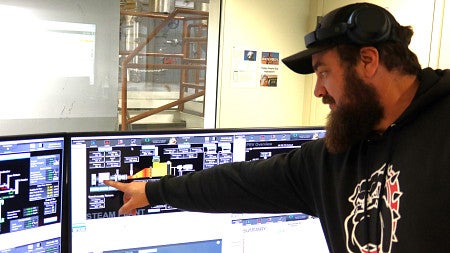
Harris exemplifies the expertise that utilities personnel bring to the job. In addition to 15 years at the UO, he’s earned special certification for electrical safety in the workplace. He’s trained on hazard analysis, safe working conditions and arc flashes — explosive electrical events when current jumps through the air.
There is, of course, inherent risk in the daylong manipulation of an electrical system that powers an entire university campus.
An incident in 2023 brought this into sharp relief. As the utilities team moved into and out of EWEB power and UO power, Information Services staff raised urgent concerns about UO’s Computing Center data center, which supports critical university-wide technology services.
The calls were fielded by interim work control manager Judy Peters, point person for testing-day communications. Seated before a screen the size of a whiteboard, Peters is akin to an air traffic controller: she coolly manages a blizzard of incoming and outgoing messages, quickly identifying critical concerns and dispatching them to the appropriate party for fast resolution.
Responding to data center staff, Peters alerted the electrical team and also contacts for incident management and university-wide communications.
Tabor tapped electrician Jered Lewis, who grabbed his “hot suit” — full-body gear that protects against an arc flash — and ran to the computing center. He quickly identified a problem with a circuit-control device and restored power by hand by working with the circuit breakers.
“It’s always stressful when you’re operating under manual, there’s more risk and you have to be cautious,” said Lewis, who has 17 years of experience. “I was happy to be able to help out, find the vulnerabilities and know how to fix them.”
Said Tabor: “Jered has the perfect skill set to walk in, recognize the situation, diagnose and save the day. If something happens [during testing], it’s going to get responded to.”
This is the challenge of electrical testing day, according to Lindsey Salfran, emergency management and continuity program director: the impacts can be so diverse and unpredictable that no amount of planning will eliminate all of them.
The day runs as smoothly as it does, she added, thanks to the teamwork and shared sense of purpose of the people behind it.
“It is a hard day, but we all agree on how important it is,” Salfran said. “It’s a testament to the people who come together to make testing day happen every year. We have the like-minded goal of doing this to better the resilience of the university.”
—Story and photos by Matt Cooper, University Communications