


When people think about study abroad, stereotypes tend to pop up: students wandering Europe with unlimited spending money, magically becoming fluent in Italian overnight or delaying graduation by a year “for the experience.”
The reality? Study abroad at the University of Oregon looks a lot different — and is a lot more practical — than most people think.
Forty-three percent of UO undergraduates study in another country and Global Education Oregon sees record enrollment year after year, including projections for summer 2026.
From STEM-friendly programs to financial aid opportunities, there is a lot to understand about study abroad at the university . . . and more than a couple myths to be popped. Read on to get the facts from the people who know the program best: the employees behind study abroad at the UO.
Myth no. 1: Study abroad is only for wealthy students.
“GEO works hard to keep study abroad financially accessible — many programs have a similar overall cost to a term at the university,” said Jenn Kuan-Petitti, finance and operations manager. “Students can use most of their existing financial aid and scholarships to fund GEO programs. GEO also provided more than $700,000 in scholarships specifically for study abroad last year. With programs ranging in length from two weeks to a full academic year, there are a wide range of options available to students.”
Myth no. 2: Studying abroad delays graduation.
“A study by UO Institutional Research indicated that students who participate in study abroad have a higher four-year graduation rate,” said Luis Ruiz, associate director for student success and analytics. “Several factors contribute to this outcome, starting with the intentional academic design of faculty-led and GEO Center programs, many of which offer specialized upper division courses that fulfill major/minor requirements. Meanwhile, intensive language immersion programs help students fulfill a year of language requirements in one term; pre-freshman programs prepare first-year students for academic success in college; and GlobalWorks internships provide invaluable work experience for future careers.”
Myth no. 3: Study abroad is basically an extended vacation.
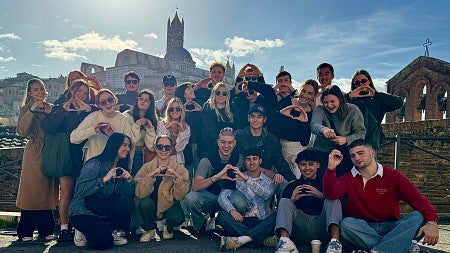
“GEO programs are no vacation,” said Will Johnson, assistant vice provost for global business development and director of GEO study abroad. “While there is plenty of time for fun and exploration, our students are generally in class, at work or conducting faculty-supervised research three to four days per week. “All GEO students are enrolled in UO courses that mirror the academic rigor expected from their home campus departments while also requiring both academic and cultural excursions. They satisfy core academic requirements while immersing themselves in a local culture and developing key skills needed to succeed in today’s global workforce — all in one program. Whether learning Britain’s role in the world through the lens of a former BBC world news editor, interning at a Singaporean financial firm, developing marketing campaigns for an organic Tuscan winery or conducting biological research high in the Ecuadorian Amazon, our students gain far more than credits when they study abroad with GEO.”
Myth no. 4: Only certain majors can study abroad.
“We have programs with courses in all majors/minors in addition to courses that fulfill UO core education requirements and language requirements,” said Ben Callaway, associate director for global programs. “But students don’t have to study abroad within their major/minor, study abroad can be a great opportunity to explore a topic that you don’t have time for on campus. Every year we have STEM majors going on Music, Arts, and Culture in London or education students wanting to fulfill their language requirement on Mexican Studies and Spanish Immersion in Querétaro. With programs as short as three weeks in the summer, there’s a lot of flexibility to study abroad while still having a job or taking classes on campus.”
Elizabeth Abbasi, associate director for global programs, added: “Faculty-led programs can help make study abroad more approachable for students because they can travel with UO faculty and peers while exploring topics relevant to different academic interests. While some faculty-led programs are tied to a specific field, many are intentionally designed to welcome students from any major who have an interest in the topic or region.”
Myth no. 5: It’s unsafe to study abroad.
Not true, according to Mark Typinski, global risk manager.
“We use extensive health and safety protocols to minimize risks and respond effectively to emergencies — this includes travel monitoring, emergency communication systems, medical insurance and more. Students get pre-departure orientation to navigate life abroad safely. There are also strong local support networks — on-site staff, emergency contacts and 24/7 assistance services. And we don’t choose locations at random — GEO staff carefully evaluate destinations using travel advisories, political stability assessments and more, and we can modify or suspend programs if safety concerns emerge.”