

Tired of the stress and costs of driving to work?
Maybe you’re considering other transportation options — but what other options are reasonable for you? Taking the bus? Carpooling? Riding a bike? Or even walking?
What if someone could just tell you the best options to the University of Oregon absent driving alone in a vehicle?
That someone would probably be Rachel Glaeser, active transportation coordinator. But there’s only one of her — and 7,000 of us in the UO workforce. It’s not realistic for Glaeser to map out personalized alternative transportation to the Eugene campus for everybody.
So Glaeser and Transportation Services are offering the next best thing: the UO Commute Tool. This interactive map presents recommended transportation options to get from wherever you are to the Eugene campus: direct bus lines, park-and-rides, bike paths, carpooling and more.
“There are a lot of options for commuting to the Eugene campus, and a lot of routes,” Glaeser said. “Our hope is that this tool will narrow the options and routes down to what’s best for you.”
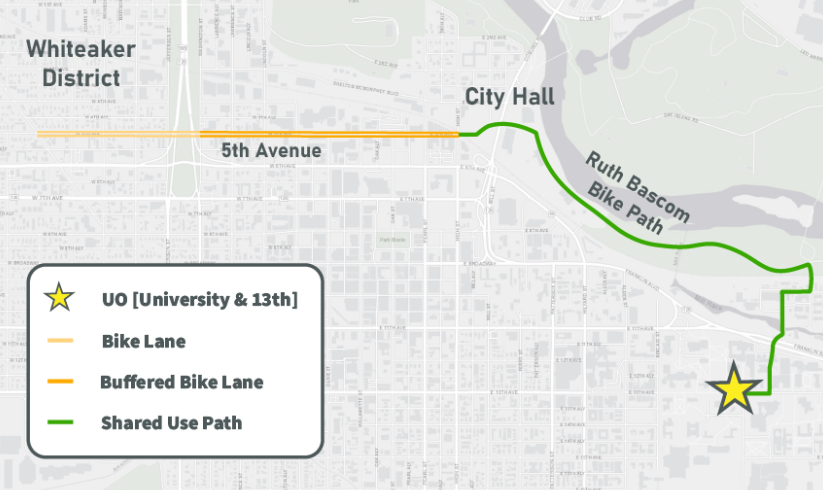
Say you live south of Amazon Park in south Eugene. Drop a pin on the tool’s digital map near your home and it shows you direct buses, park-and-ride lots, carpooling and options to ride your bike or use bike share. With each bus recommendation, you get directions to the closest direct line — a walk of less than 10 minutes — and the buses that go straight to the UO. Pick the park-and-ride and you get directions to the nearest one. Opt for biking and the tool presents the quickest route on protected bikeways and shared-use paths.
All options are presented as itineraries. Users get step-by-step directions if multiple types of transportation are involved — say, walking to a park-and-ride and catching a bus, or using multiple bike paths.
“We made the itineraries realistic for what people might use,” Glaeser said. “We’re thinking about total commute time. If you have to transfer to a different bus, that’s not as appealing as taking a direct route. These are recommended routes.”
Brier Turnbull, a UO graduate student in planning, public policy and management, used her skills in geographic information systems to build the tool. She got guidance on the project from Glaeser and Transportation Planner Paul Comery, who responded to a focus group of UO employees who said help with commute planning could put a dent in single-occupant vehicle trips.
One feature of the UO Commute Tool you won’t find with Google maps is information on transportation benefits available to UO employees. With a bus itinerary, for example, you’ll get a link to your UO free bus pass.
The launch of the tool couldn’t come at a better time, Glaeser said — there are scores of active and sustainable transportation events with prizes and other incentives occurring over April and May.
—Matt Cooper, University Communications