

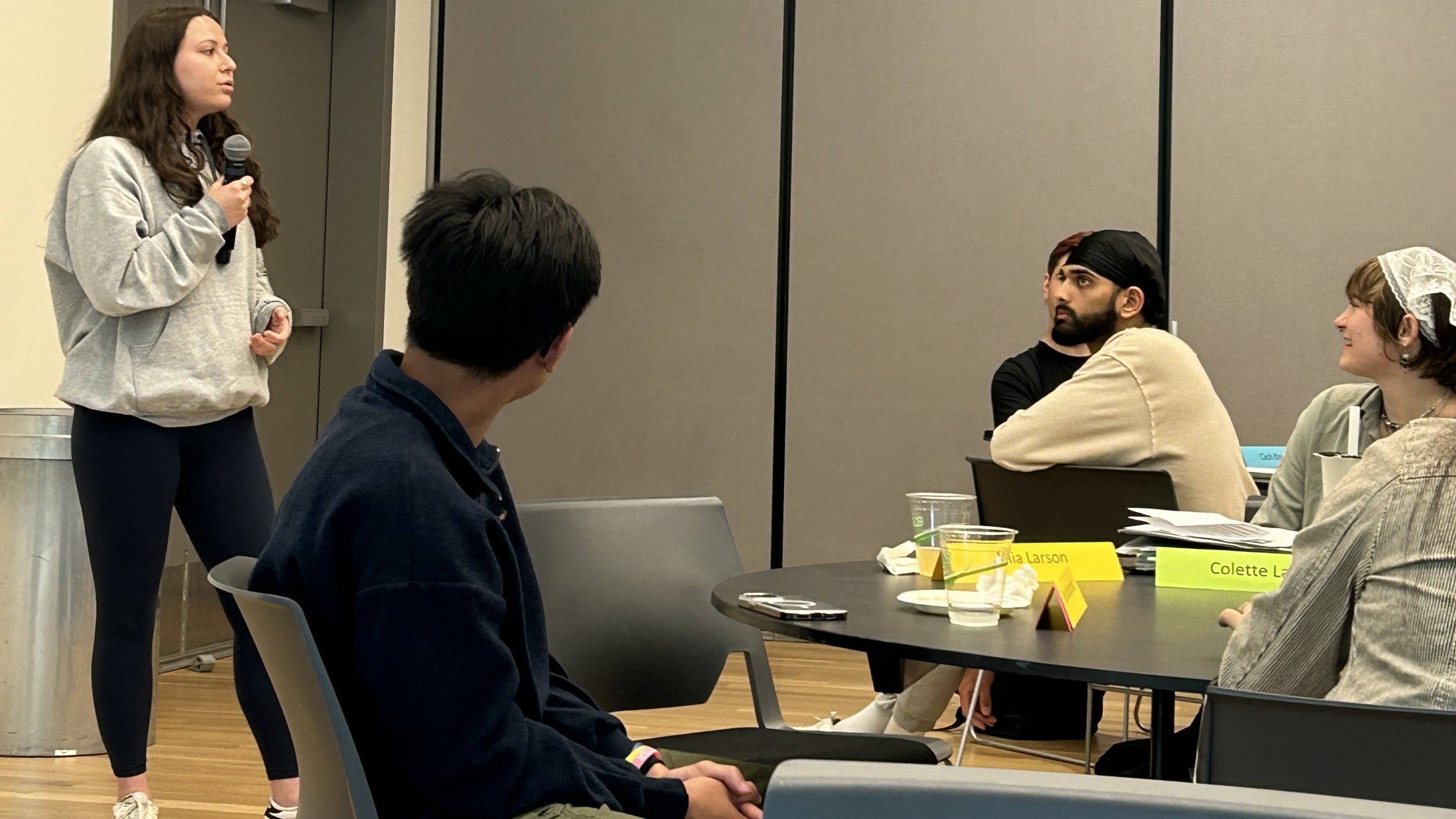
About the only thing students don’t do as interns for the University of Oregon is the cliché coffee run.
They create training manuals for Administrative Services. They build financial models for Utilities and Energy. They redesign websites for Information Services, help run employee recognition events for Human Resources, do outreach for Safety and Risk Services and analyze parking permit strategies for Transportation Services.
This is the UOAdmin Internship, a program that puts students to work in departments that run core university functions. Over an academic year, students in paid posts learn what jobs they like — and don’t — while working closely with employees.
The seven-year-old program is the brainchild of Jamie Moffitt, senior vice president for finance and administration, whose own internship experiences as a graduate student were as different as night and day.
An internship one summer was so bereft of front-end planning she wasn’t even given a desk. The next summer, an employer gave her not just a desk but a seat at the table for high-profile board meetings and a substantial role in a project.
“I really wanted to replicate the second experience,” Moffitt said. “I wanted to make sure students got multiple professional experiences and were able to work on substantive projects.”
The 35-plus departments in Finance and Administration responded enthusiastically to Moffitt’s idea and the program launched in 2019: a dozen or so students working in paid internships across three departments over an academic year.
Last fall, for example, Andrew Wheeler of Information Services put senior Joaquin Esparza to work on the technological marvel reshaping the world: artificial intelligence or AI.
As associate chief information officer for customer experience and artificial intelligence, Wheeler recognized Esparza could be invaluable in better understanding how UO students use AI. The two developed a series of questions and Esparza contacted students through social media and email, setting up interviews and gathering nearly 200 use cases.

Esparza’s connection to fellow students, Wheeler said, “was a unique opportunity for us to harvest information and hopefully people were more open to respond to him [than to traditional survey methods].”
Not that it was easy for Esparza — the project required him to sharpen his communication skills in conducting the interviews.
“Getting conversations started was very difficult — it forced me out of my comfort zone,” he said. “I had never conducted interviews and I used to get a little nervous. But repeating those meetings over and over slowly destroyed that fear. I feel a lot more comfortable going to meetings now.”

Finance major Alely Ruiz-Quiroz drew insights from jobs in Administrative Services and the Vivian Olum Child Development Center that she’ll use as she pursues a goal of starting her own business.
“All my supervisors are great leaders, and I’ve seen them navigate through things and how they do it,” she said. “‘This is what I could offer my people, this is what I could give them to make them want to come to work or feel part of the team, this is what a team should do when everything’s on fire.’ The internship helped me a lot to see how to organize and run a team.”
Through the UO internship, students such as senior John Delay get validation about the kind of work that might suit them.

Delay, an accounting and data science major, shadowed accounting staff last winter. He got a whirlwind introduction to payroll and paycheck processing, state and federal taxes, benefits, reporting and more.
“I would think about the work even outside of the internship — like, ‘how does this work?’” Delay said. “It took up mental real estate, in a good way. That’s an indicator, I guess, that maybe I’m on the right career path.”
Controller Kelly Wolf joked about that — “he needs to get a hobby,” he said, laughing — but was sincere in extolling the intern’s strengths. The associate vice president for business affairs included Delay in financial review meetings and met with him for whiteboard sessions.
“John’s questions were insightful,” Wolf said. “I’m thrilled that we were able to give him that experience. You learn tons of theory in the classroom but actually doing the work reinforces what you’re learning.”
Contrary to Delay’s example, some interns find that the work they thought they’d enjoy isn’t a good fit. And that’s valuable, too.
Debbie Sharp, who runs the internship as project manager in Finance and Administration, said it emphasizes “the freedom to fail.” Students have the latitude to discover which kinds of jobs suit them, and which don’t.
“It’s a safe environment to explore ‘what kind of leadership do I need? What kind of team? Do I like an open office plan? Maybe I just don’t want to do Excel, maybe I want to be with people,’” Sharp said. “It’s not just about the hard skills — it’s about exploring the workplace. We are a learning institution and learning about what you don’t like is really important.”
Take internship alumna Mia Larson, for instance.

A self-described introvert, Larson assumed she would gravitate to technical, detail-oriented work during her year with the program in 2023-24.
Instead, she discovered she’s a people person: working in Human Resources on professional development and UO Kids on Campus Day proved so satisfying Larson joined the department as a student employee. After graduating, she landed a full-time position there; she recently celebrated her first anniversary as learning and development operations specialist.
“This internship meant everything as far as launching my career,” Larson said. “It’s just such a good way to learn more about yourself, learn more about maybe 10 things you don’t like and one thing that you do. They’re both important to figure out.”
—Matt Cooper, University Communications