

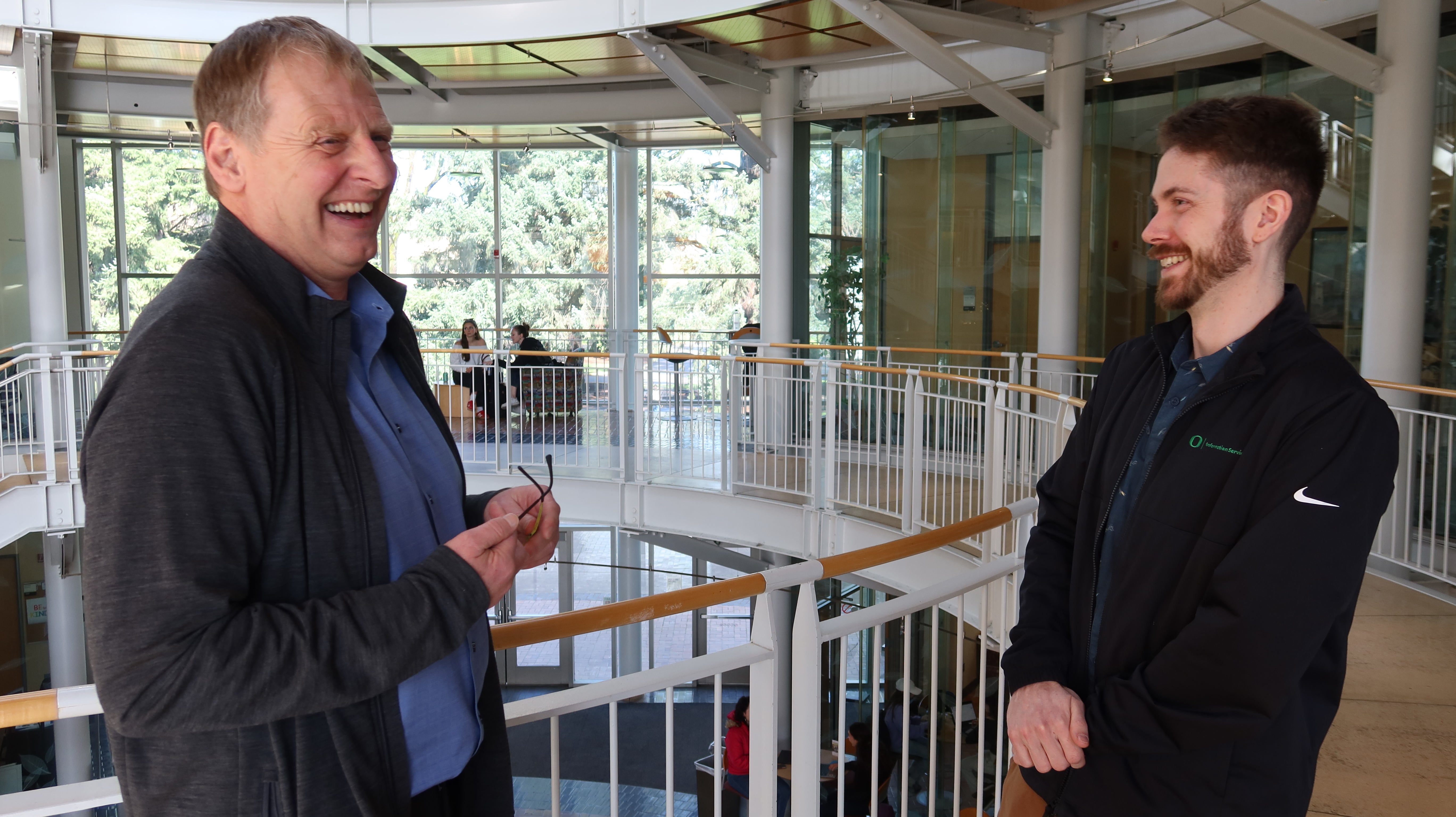
Business professor Ralph Heidl teaches technology and innovation. He’s always been struck by the speed at which mobile devices such as smartphones and tablets changed how companies operate.
That was before artificial intelligence. AI is changing the business world again — this time, seemingly overnight.
The breathtaking rate at which businesses are incorporating AI is “something that I had never seen before,” said Heidl, an associate professor of management in the Lundquist College of Business. “I asked myself, ‘how do I bring this into the classroom?’”
Heidl knew he was asking for a headache. He didn’t just want to teach students AI for business — he wanted them to use it in practice. But setting up students with these sophisticated digital tools promised to be exceedingly complicated and potentially expensive.
Fortunately, Heidl had support from technology experts in Information Services.
The university’s central technology unit supports academics like Heidl with tech specialists like Lucas Crownover, William Winter and Patrick Mollman. With their support over two years, Heidl developed innovative business courses that are preparing students for AI-enabled careers while helping Information Services lay the groundwork for other faculty to use powerful AI tools quickly, safely and successfully.
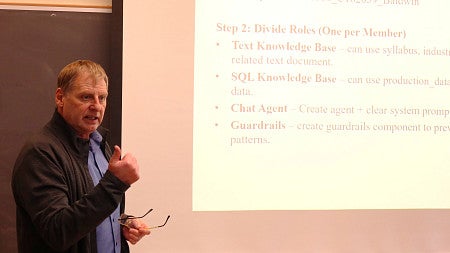
Heidl wanted students to build an AI assistant and equip it with enough business knowledge to make decisions as a chief product officer or chief marketing officer. He and the Information Services team tried hosting the necessary digital tools on UO systems, even tapping the high-performance computing cluster, a group of powerful computers that the unit runs for the university.
No luck. AI is “super hungry” for computing power, Crownover noted, and response times for the students’ AI assistants slowed to a crawl. Ultimately, the problem was solved by turning to an AI platform available for a charge through the cloud, which includes remote servers accessed over the internet.
Heidl also faced dual challenges of ensuring students can access the cloud-based AI platform securely and that their usage will stay within budget.
Be advised: AI tools in the cloud aren’t generally organized for just anybody to find what they need. These digital environments are complex, Crownover said — it takes specialized expertise to navigate them without accidentally activating expensive extra services.
Information Services has this experience and happily took the technical burden off Heidl. The tech team set up the necessary AI tools on Amazon Web Services, which students access with their Duck ID accounts. The team helped Heidl manage costs by configuring the platform to give him a running tally of usage charges.
The partnership between Heidl and Information Services to train students for AI-enabled jobs is a shining example of the UO’s strategic priority to be a leader in career preparation. It exemplifies the role the institution can play in student success when experts collaborate to bring practical applications into the classroom. With this project, John Schaus, BS ’75, helped inspire the Lundquist College of Business to get ahead of the AI curve and has financially supported the college’s efforts in this space, said Bob Brothers, director of development.
Heidl added the AI projects to a course on technology and innovation management in the Oregon Executive MBA program, and to an undergraduate honors course in business strategy and planning.
Senior Audrey Nordby, a student in the latter, said she is building skills in and knowledge of AI business tools that are already paying off professionally.
Nordby has been interning with an information-on-demand company that urged her, she said, to “get as much learning about AI as we possibly could.” Thanks to Heidl’s course, she’s helping company leadership make informed decisions about an AI agent in development and how to navigate questions such as database resources and information security.
“This class is super relevant,” Nordby said. “AI has strong areas and weak areas, and this class has taught me where the human touch is really necessary. It’s important to know how to implement AI and what the workforce is going to look like. When I’m telling employers I know about all this stuff and can implement it, it positions me better.”
Heidl, a jovial sort quick with a smile, said Information Services helped keep his headaches to a minimum as they worked together to solve the challenges of bringing sophisticated AI tools into the classroom.
“You have to be very pain tolerant,” Heidl said, laughing. “Information Services was incredibly supportive on this whole journey. Their contributions have enabled an absolute frontier offering in innovation management and artificial intelligence for our students.”
For Information Services, the partnership provided a wealth of knowledge that will enable the unit to advise other faculty who want to build similar AI capabilities.
“Information Services is here to help,” Crownover said. “If you’re wondering, ‘how can I do this,’ we will be happy to guide you. At the end of the day, it’s about supporting students and adding value to their academic experience and career preparation.”
—Story and photos by Matt Cooper, University Communications