

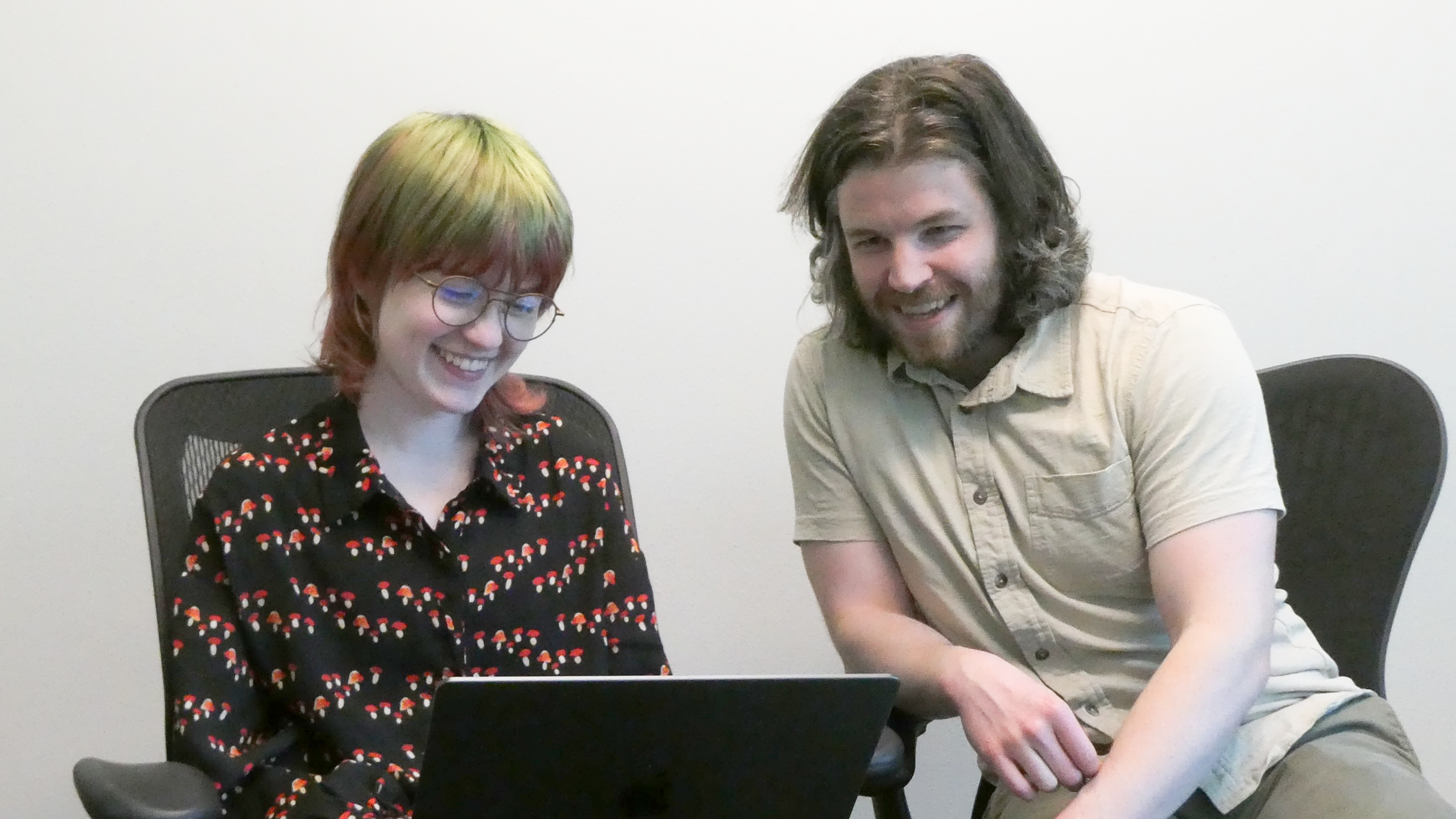
From the moment it began, the pressure was on. Six students. Six laptops. One supercomputer. Forty-eight hours to process mountains of data.
And no help from mentors beyond pizza and energy drinks.
Six students from Oregon completed their first-ever supercomputing contest in November — and got career skills in the process — thanks to coaching from a University of Oregon technology expert.
William Winter, a research software engineer, spends most of his time helping faculty and researchers use the UO’s high-performance computing cluster, a network of hundreds of powerful computers in Information Services. The system, run by the department’s Research Advanced Computing Services, performs highly complex analyses on everything from physics to history in hours or days instead of weeks.
Supercomputing 101
Last year Winter embarked on a new challenge: training six undergraduates across the state to run such systems in a global competition called IndySCC.
During the nonstop, two-day event, teams from colleges around the world tackle tasks on a high-performance computing system. They run sophisticated software, such as a model of Earth’s climate that scientists use to explore scenarios for future temperatures.
“It’s a one-of-a-kind professional experience,” Winter said. “It’s very cool and very un-classroom.”
Stella Greenvoss, a UO computer science major in the Clark Honors College, signed up despite being new to high-performance computing. She joined teammates from Oregon State University, Portland State University and Portland Community College, all in a similar boat of inexperience.
To bring them up to speed, Winter and co-mentor Marko Markoc, a research computing system administrator at Portland State, led workshops about tools, processes and troubleshooting — everything required to run such complex systems.
And what is required?
High-performance computing is like teaming up with friends on a jigsaw puzzle. By dividing the work, you can finish more quickly. If the puzzle is really big — think 50,000 pieces — you might need a “puzzle master” to decide how to divvy up the puzzle, what order to complete the sections in, and how to bring all the pieces together.
The undergrads needed to become puzzle masters in six short months.
Learning by doing
In May 2025, they jumped in, using the Oregon Regional Computing Accelerator. The high-performance system had just launched at Portland State for researchers statewide.
“High-performance computing is about all these systems working together, and any one component can go wrong at any time,” Winter said. “The students were launching their own computer clusters and running stuff and seeing stuff break and fixing it and doing the job.”
That summer, the students gained remote access to the supercomputer for the competition: Jetstream2, located at Indiana University. With their mentors pointing the way, they started installing programs and getting set up on the supercomputer.
Before long, it was go time. In November, the team traveled to St. Louis, Missouri, for the competition.
The six students divided into three pairs to operate the climate model and two other programs simultaneously. Greenvoss and her partner took troubleshooting shifts around the clock as they struggled to get the massive climate application running. Waking up hours before dawn, Greenvoss managed to kick it off by 6 a.m. on the second day. “I felt so good. My teammate was so excited. I think that was my best moment.”
The Oregon team made a strong showing, completing entries for every task and scoring around the median among contestants.
“It was overwhelming,” Greenvoss said. “But it was really fun.”
Applying the knowledge
Greenvoss and her collaborators built skills they could apply to careers as cloud engineers, systems administrators, software engineers or academics doing computational research. They also practiced teamwork, communication, adaptability and performing under pressure.
“High-performance computing is a specialized field,” said Dan Majchrzak, director of Research Advanced Computing Services. “If we expose 20 people to this field and we get three, that’s a huge increase in the number of people that even know what it’s about.”
Greenvoss immediately applied her newfound skills to a student job on Winter and Majchrzak’s team. She’ll keep building her knowledge this summer through a research internship in parallel computing at Los Alamos National Laboratory in New Mexico.
“It’s really fun to come to work and be thrown random problems and see if I can solve them,” Greenvoss said. “Everything I’m doing is helping researchers advance their fields. That’s exciting for me.”
Expanding the program
Winter and Markoc have launched Oregon’s 2026 competition team, with Greenvoss returning.
To support the growing interest in high-performance computing, they’ve also started a statewide student club.
Both the club and the team emerged from student workforce efforts connected to the Cyberinfrastructure Alliance for Oregon. That project is helping shape Oregon’s statewide strategy for artificial intelligence, advanced computing and research cyberinfrastructure, funded by a National Science Foundation planning grant.
Contact racs@uoregon.edu for more information.
For Winter, the best part of the monthslong contest experience was connecting with Greenvoss and her teammates.
“Having this crop of students to build relationships with, be a mentor to, and being able to share some high-performance computing knowledge with them and set them on their way in the HPC world has been really cool and rewarding.”
—Story and photo by Nancy Novitski, Information Services